

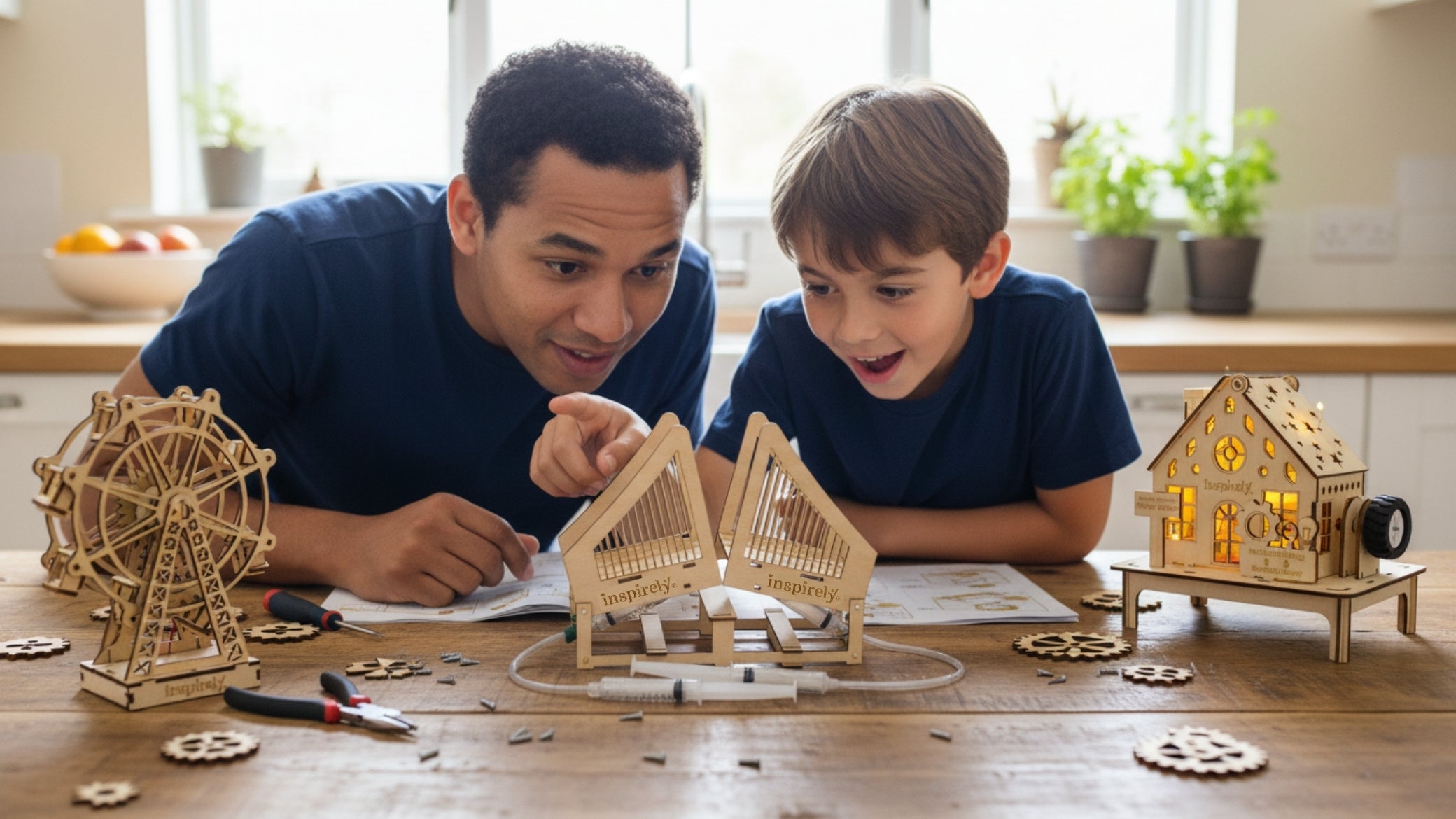
The Best STEM Kits and Toys to Buy in 2026 - An Honest Parent's Guide
Every parent has bought the educational gift that lasted three days.
The science kit that goes to recycle bin after one experiment. The coding game that got deleted when a more entertaining app arrived. The STEM toy with impressive packaging that produced nothing a child could show anyone.
The problem is not your instinct. Your instinct was right. You wanted something that builds real skills. The problem is that most products carrying the STEM label were not designed to deliver that - they were designed to sell it.
This guide tells you what actually works in 2026. An honest look at every major product category, a clear buying framework, and a straight answer on which kits produce the skill development parents are looking for - and which ones just look good on the shelf.
What Has Changed in the STEM Market in 2026?
Three things are different about buying STEM products in 2026 compared to even two years ago.
1. The Market Is Saturated With Self-Labelled STEM Products
Any product can call itself STEM. The acronym carries no legal definition, no minimum standard, and no required third-party verification. A craft kit with a science theme, a coding game with a math level, a magnetic tile set with a geometry reference on the packaging - all of these are sold as STEM products. Most parents have no reliable way to distinguish between a product that delivers genuine engineering skill development and one that borrowed the label.
2. School Boards Are Now Speaking the Same Language
Parents attending curriculum nights, reading board newsletters, and speaking with teachers are hearing a consistent message across Canada and the US - experiential learning, career-connected skills, hands-on outcomes. This shift in school board language is changing what parents expect from educational products at home. A STEM product that cannot demonstrate curriculum-connected learning outcomes is increasingly difficult to justify against that benchmark.
3. Independent Authentication Now Exists
STEM.org is an independent, US-based educational research and credentialing organisation that has been assessing educational products since 2001. Authentication requires an independent panel of accredited educators to verify that a product delivers on specific, documented learning outcomes. Many products in the STEM category do not hold this kind of trust signal. The ones that do represent a meaningfully different standard of evidence.
The One Question That Cuts Through All the NoiseBefore buying any STEM product in 2026, ask this: what does the child take home when they are done - and can they explain how it works to someone else? If the answer is nothing, or vaguely, the product did not deliver on its educational claim regardless of what the packaging says. |
The 5-Point Buying Criteria - Use This Before Any Purchase
Apply these five questions to any STEM product before spending a dollar. A strong product scores four or five out of five. A weak product scores two or fewer - regardless of how impressive the packaging is.
One additional lens to apply across all five criteria: does the product function as an experiential learning tool - one that produces genuine skill through direct physical experience - and does it leave room for open-ended investigation after the structured activity ends? The best STEM products answer yes to both.
|
Criteria |
What to Look For |
Red Flag |
|
Working outcome |
A functional model the child can operate and demonstrate |
Static display or no physical output |
|
Independent authentication |
STEM.org authentication or equivalent third-party assessment |
Self-labelled STEM with no external verification |
|
Age-matched complexity |
Verified developmental alignment |
Broad age range with no developmental rationale |
|
Take-home value |
Child keeps and uses the finished model after the session |
Activity-based with no lasting physical result |
|
Independent completion |
Child try to build themselves - with or without adult supervision |
Require STEM or an expert adult to facilitate |
|
Open-ended extension |
Kit works as investigation platform after structured build ends |
Activity is consumed and done - no further inquiry possible |
The Main STEM Product Categories in 2026 - An Honest Assessment
There are four main product categories in the STEM market right now. Each has genuine strengths. Each has real limitations. Here is the honest picture.
Category 1 - STEM Subscription Boxes

|
STEM Subscription Boxes (e.g. KiwiCo) Best for: Monthly variety, ages 3 to 16, convenience Good for families who want consistent monthly engagement. May be less suitable for parents seeking deep, documented engineering skill development. ✓ Consistent monthly delivery - no planning required ✓ Wide age range from toddler through teen ✓ High production quality and polished presentation ✓ KiwiCo backed by NGSS alignment and a 2024 Johns Hopkins University study on student motivation ○ Not STEM.org authenticated - no independent certification of learning outcomes ○ Subscription model optimises for novelty over depth ○ American-designed - no Canadian curriculum connection |
The honest verdict: subscription boxes are a strong choice for parents who want a reliable monthly activity with broad age coverage. They are a weaker choice for parents who want documented, transferable engineering skills with a working take-home model every session. For the latter goal, a one-time authenticated kit produces more measurable learning per dollar spent.
Category 2 - Open-Ended Building Sets
|
Open-Ended Building Sets (e.g. LEGO, magnetic tiles) Best for: Creative exploration, ages 3 to adult, open play Excellent for developing spatial reasoning and creative confidence. Not designed to produce specific engineering skills or documented learning outcomes. ✓ Develops spatial reasoning and creative problem-solving ✓ Highly replayable - same set used for years ✓ LEGO is one of the most researched educational toys globally ✓ Works across ages 3 to adult with appropriate sets ○ LEGO Education SPIKE Prime and SPIKE Essential are retiring - end of sales June 30, 2026 |

The honest verdict: LEGO and open-ended building sets belong in every child's home. They are not a replacement for structured engineering kits - they are a complement. A child who builds freely with LEGO and builds a STEM.org authenticated kit is getting the best of both. Neither replaces the other.
Category 3 - Coding Apps and Digital STEM Tools
|
Coding Apps and Digital STEM Tools (e.g. Scratch, Tynker) Best for: Logic and sequencing, ages 7 to adult, screen-based learning Genuine value for logical reasoning development. Limited in spatial skills, fine motor development, and the career-connected outcomes that physical engineering builds. ✓ Teaches logical sequencing, conditional thinking, algorithmic reasoning ✓ Low cost - many free or low-subscription options ✓ Widely available on existing devices ✓ Scratch Foundation provides research on learning outcomes ○ Screen-based - does not develop spatial reasoning or fine motor skills ○ Built for engagement metrics - session length, not skill transfer ○ No physical take-home outcome ○ Narrow career pathway - coding only, not broad STEM |

The honest verdict: coding apps are useful for one specific skill set - logical sequencing. They should not be confused with a complete STEM education. A child who only uses coding apps is developing one corner of a much larger skill map. Physical building addresses the rest.
Category 4 - Authenticated STEM Kits
|
Inspirely STEM Project Kits Best for: Documented engineering skills, ages 6 to 14, working take-home model every session The strongest option for parents who want independent authenticated learning outcomes, a working model the child keeps, and a product designed by students who understand what actually engages children. ✓ STEM.org authenticated - independently assessed learning outcomes ✓ Every kit produces a working model the child takes home ✓ Patent protected designs. ✓ Designed in Canada - Brampton, Ontario ✓ School fundraiser program - 35 to 50% revenue back to school ✓ Ships across Canada and the USA ○ Age range 6 to 14 - does not cover toddlers or under-6 ○ One-time purchase per kit - not a subscription model ○ Longer build times (45 to 120 min) - suits focused sessions rather than casual play |

|
Beyond the Build - Open-Ended Inquiry With Inspirely Kits The instruction guide is the starting point, not the ceiling. Once the Hydraulic Bridge is complete, a child can investigate what happens when the fluid level changes, test whether the bridge holds under weight, modify the launch angle of the catapult, or measure the electrical output of the generator under different conditions. Every Inspirely kit is designed as an experiential learning platform - the structured build produces the working model, and the working model invites independent investigation that mirrors how engineers, scientists, and innovators actually work. |
|
The Story That Changes How Your Child Relates to the Kit Inspirely kits were designed by Jay and Vihan Tailor - brothers in Grade 9 and Grade 7. Jay competed at DECA ICDC 2026 in Atlanta in the Business Growth Plan category - the international youth business championship. Together they hold 6 design-protected designs. When a child learns that the kit they are holding was designed by a student their age who holds international patents - something shifts. The kit is no longer just an activity. It is a proof of what is possible. |
The Age-by-Age Buying Guide for 2026
Here is the specific recommendation for every age band from 6 to 14 - with the reasoning behind each choice.
Ages 6 to 8 - Best Buy: Inspirely Basketball Catapult
At ages 6 to 8, the most important factor is a dramatic, immediate working outcome. The child needs to see and feel the result of what they built. The Basketball Catapult delivers this - a functional launch mechanism that the child adjusts, tests, and demonstrates repeatedly after the build is complete.
-
Core concept: Simple machines, lever mechanics, force and motion
-
Build time: 45 to 60 minutes
-
STEM.org authenticated: Yes
-
Best for: Ages 6 to 8, Grades 1 to 3

Open-ended extension: once the catapult is built and working, a child can investigate how changing the lever arm length affects launch distance, test different launch angles, add weight to the arm and observe the outcome, or attempt to hit a target consistently. The kit becomes a physics investigation platform. No extra materials needed - just curiosity.
Also consider: LEGO Classic sets for open-ended creative building alongside the structured kit. The two products serve different purposes and complement each other well at this age.
Ages 8 to 10 - Best Buy: Inspirely Hydraulic Bridge
Ages 8 to 10 is the peak STEM engagement window. Spatial reasoning is most responsive to physical input. Attention span is long enough for a real engineering build. The Hydraulic Bridge sits at exactly the right level of challenge - complex enough to require genuine effort, achievable enough that every child completes it and operates the working result.
-
Core concept: Hydraulics, fluid pressure, structural load distribution
-
Build time: 75 to 90 minutes
-
STEM.org authenticated: Yes
-
Best for: Ages 8 to 10, Grades 3 to 6

Open-ended extension: once the bridge is working, the investigation begins. What happens if you change the fluid volume in the syringe? Can the bridge support weight? What is the maximum load before the mechanism strains? Can you design a way to make it open faster? Out of Water and Air, which one has more viscosity? These are the questions real civil engineers ask - and a child with a working Hydraulic Bridge in front of them can begin answering them immediately.
Classroom extension: for teachers using this kit in a school or camp setting, the Hydraulic Bridge is an ideal open-ended anchor for a unit on structures, fluid mechanics, or engineering design. Students who have built the structured model can be challenged to modify it, document their investigation, and present findings - turning a single session into a multi-day inquiry project.
Also consider: House Igloo Engineering Kit for children who show interest in architecture or electronics. A KiwiCo subscription runs well alongside an Inspirely kit for families who want monthly engagement plus one deep engineering experience per term.
Ages 8 to 11 - Best Buy: Inspirely House Igloo Engineering Kit
The House Igloo Engineering Kit introduces structural design and basic sound sensor electronics. It works particularly well for children showing interest in architecture, building systems, or technology - and for gift-givers who want something slightly different from the Hydraulic Bridge for a child in the same age range.
-
Core concept: Structural engineering, sound sensors, basic electronics
-
Build time: 60 to 75 minutes
-
STEM.org authenticated: Yes
-
Best for: Ages 8 to 11, Grades 3 to 6
Ages 10 to 13 - Best Buy: Inspirely Dynamo Generator Power House
The Dynamo Generator Power House is the kit for the child who asks 'how does electricity work?' and actually wants the real answer. The build produces a working generator mechanism - the child creates electrical output and understands the conversion principle behind it. This kit also connects most directly to the career fields governments across Canada and the US are prioritising - sustainable energy, electrical engineering, and clean technology.
-
Core concept: Energy conversion, sustainability, electrical generation
-
Build time: 90 to 120 minutes
-
STEM.org authenticated: Yes
-
Best for: Ages 10 to 13, Grades 5 to 8

Open-ended extension: once the generator is producing output, a child can investigate what affects the amount of electrical output, experiment with connecting different components, measure the relationship between rotation speed and power, and design modifications that increase efficiency. This is the same investigative process used in real sustainable energy engineering - the kit is the starting point of that inquiry, not the end of it.
Ages 10 to 13 - Best Buy: Inspirely Ferris Wheel
The Ferris Wheel is the most complex kit and the most visually dramatic outcome in the range. Working circuits and rotational mechanics produce a functional Ferris Wheel the child built from wooden components. The design of Inspirely Ferris Wheel kit is patent protected - a detail that means something to children who hear it and to parents who care about the quality of what they are buying.
-
Core concept: Circuits, rotational mechanics, mechanical structures
-
Build time: 90 to 120 minutes
-
STEM.org authenticated: Yes
-
Best for: Ages 10 to 13, Grades 5 to 8

Open-ended extension: once the Ferris Wheel is turning, a child can investigate how circuit resistance affects rotation speed, test what happens when one circuit component is modified, design a way to measure rotational velocity, or attempt to add a lighting element to the structure. The completed model is a working electronics platform - every modification teaches a new concept.
Quick Reference - Best STEM Kits and Toys by Age 2026
|
Age |
Best Kit or Toy |
Type |
Price (USD) |
Best For |
|
Ages 3 to 7 |
LEGO Classic |
Open building |
$30 to $80 |
Creative spatial play |
|
Ages 6 to 8 |
Inspirely Basketball Catapult |
Authenticated kit |
~ $29.95 |
Simple machines, working outcome |
|
Ages 7 to 12 |
Scratch (free) or Tynker |
Coding app |
Free to $120/yr |
Logical sequencing, screen-based |
|
Ages 8 to 10 |
Inspirely Hydraulic Bridge |
Certified kit |
~ $29.95 |
Hydraulics, peak STEM window |
|
Ages 8 to 11 |
Inspirely House Igloo Kit |
Certified kit |
~ $29.95 |
Structures and electronics |
|
Ages 8 to 16 |
KiwiCo Subscription |
Monthly box |
$20-$50/month |
Monthly variety, convenience |
|
Ages 10 to 13 |
Inspirely Dynamo Generator |
Certified kit |
~ $29.95 |
Energy, sustainability |
|
Ages 10 to 13 |
Inspirely Ferris Wheel |
Certified kit |
~ $29.95 |
Circuits, showpiece outcome |
For Teachers, Camp Directors, and School Councils
Volume pricing applies for orders above 6 kits. Camp bundles start at the Ignite tier (6 to 12 kits at $38.95 per kit) and scale to the Signature Season tier (36 to 48 kits at $29.95 per kit). School fundraising partnerships return 35 to 50 percent of kit revenue back to the school - turning every kit purchase into both a learning experience and a direct contribution to the school budget.
For classroom and camp use specifically: Inspirely kits function as both structured experiential learning activities and open-ended investigation platforms. The structured build gives every student a working model in a single session - which satisfies curriculum outcome requirements. The open-ended investigation phase allows teachers to extend the activity across multiple sessions, assign independent inquiry questions, and connect the physical model to broader unit themes in science, technology, or engineering. Kits can be used with full instructions for the structured outcome, or with instructions withheld for older students who are ready to problem-solve the build independently.
Contact hello@inspirely.education with your organization type, approximate kit count, and event or program date for a custom volume quote. You may also check The Complete Parent's Guide to STEM Kits for Kids (2026)
Where to Buy and How to Save in 2026?
Individual Kit Purchase
Individual Inspirely kits are available directly through inspirely.education. Retail price $19.95 to $53.95 USD per kit. Ships across Canada and the USA. Standard shipping 5 to 10 business days depending on location.
Through Your Child's School
If your child's school has an Inspirely fundraising partnership, ordering through that channel means your purchase contributes 35 to 50 percent back to the school budget. Ask your school council if an Inspirely partnership is active. If not, the school council can set one up by contacting hello@inspirely.education.
Bundle Pricing for Multiple Kits
Ordering 3 kits through the starter bundle saves compared to individual pricing. Ordering 5 kits through the Camp at Home bundle represents the strongest per-kit value for a single child's year of STEM learning.
FAQs - Best STEM Kits and Toys 2026
What is the single best STEM kit to buy in 2026 for a child aged 8 to 10?The Inspirely Hydraulic Bridge. Ages 8 to 10 is the peak STEM engagement window - when spatial reasoning is most responsive to physical input and attention span is long enough for a real engineering build. The Hydraulic Bridge teaches fluid mechanics through a working hydraulic mechanism, builds in 75 to 90 minutes, and is STEM.org authenticated. Every child takes the completed working model home. |
Is KiwiCo or Inspirely better for a 9 year old?For a 9 year old whose parents want a working individual engineering model and independent authentication of learning outcomes - Inspirely. For a family who wants consistent monthly variety across a wider range of activities without a specific engineering outcome goal - KiwiCo delivers well. Both are legitimate products with different philosophies. The right choice depends on what you are trying to achieve. For more specifics, please visit individual company's website and check latest. |
Are STEM kits worth buying or are they just expensive toys?The right STEM kit is worth buying. The wrong one is an expensive toy. The distinction comes down to two things: independent authentication and open-ended depth. A STEM.org authenticated kit has been independently assessed against documented learning outcomes - the educational claim is verified, not just printed on the box. And a kit with genuine open-ended extension value functions as an experiential learning platform long after the structured build ends - the child tests, modifies, investigates, and discovers independently. Inspirely kits hold STEM.org authentication and are designed for both structured and open-ended use. |
What age should a child start using STEM kits?STEM building kits are most effective from age 6, when fine motor systems are ready for precision work. The peak developmental return window is ages 8 to 12 - when spatial reasoning is most responsive to physical building and when abstract thinking is strong enough to connect a physical outcome to an underlying engineering principle. Starting at 6 and working through the kit range to age 13 covers the complete high-value window. |
Can I order Inspirely kits in the United States?Yes. Inspirely ships across Canada and the USA. All kits are STEM.org authenticated. US school councils can also access the school fundraising program - contact hello@inspirely.education to set up a school partnership. |
Do parents need engineering knowledge to help their child with an Inspirely kit?No. Every Inspirely kit includes an step-by-step build guide designed for children to follow independently. The parent does not need to know how it works. They need to be present for the moment the model works for the first time. That moment is worth showing up for. The kit also comes with facilitator guide - helpful for even non STEM teacher to run STEM program in school classroom or event. |
|
Editorial Note: This guide was written to help parents make informed decisions. Inspirely is the publisher of this guide. KiwiCo is a registered trademark of KiwiCo Inc. LEGO is a registered trademark of the LEGO Group. All third-party products are referenced for comparative and informational purposes only. |
Shop the Best STEM Kits of 2026STEM.org authenticated. Patent-protected designs. Ships across Canada and the USA. Shop at inspirely.education. Interested in learning more about STEM Kits? Check out our complete guide |
Share:
Give Campers Career Confidence in One 90-Minute Session
How to Make Any Event Unforgettable With STEM Kits?