

How Schools and Camps Across Canada and the US Are Building Career-Ready Kids Through Hands-On STEM?
Every school has run a science fair. Every camp has tried a coding afternoon. And every teacher and camp director knows the same quiet truth: most of it gets forgotten by the following Monday.
The experience that sticks is different. It has a working outcome the child built with their own hands. It goes home with them. It sits on a shelf in their bedroom. It comes up at dinner. It becomes the thing they talk about when someone asks what they did at school or camp this year.
That is not just good programming. That is what governments across Canada and the United States are now actively calling for - and funding. The shift toward experiential, career-connected learning is no longer a trend. It is policy. And the schools and camps running structured STEM kit sessions are already aligned with it. Interested in learning more about STEM Kits? Check out our complete guide.
This article breaks down what that looks like, why it is happening now, and how to bring it into your school or camp program.
Why Governments Across Canada and the US Are Demanding This Shift?
From Ontario to British Columbia to Alberta to Washington DC, education ministries and federal departments are saying the same thing in different words: classroom instruction alone is not producing career-ready students. The gap between what schools teach and what students need to succeed in high-paying, in-demand careers is widening. And the solution they are all pointing toward is the same - experiential learning with real-world outcomes.
This is not a philosophical shift. It is a policy and funding shift. Understanding it is important for every school administrator, camp director, and program coordinator making programming decisions in 2025 and 2026.
The shift is happening at every level of government across North America - and the schools and camps responding to it now are the ones positioning their students, and their programs, ahead of the curve.
For school administrators, this shift is significant. Programs that can demonstrate curriculum-aligned, experiential learning outcomes are increasingly positioned to access both board approval and provincial or federal funding streams. For camp directors, it means that parents who attend school council meetings and read board newsletters are arriving at camp registration with this language in their heads. The camps that speak it back to them win.
What Career-Ready Actually Means for a 10-Year-Old?It does not mean knowing which career to choose. It means developing the cognitive habits that make every career accessible - the ability to take on a challenge without knowing the answer in advance, iterate when the first attempt fails, and communicate what was learned to someone else. Every Inspirely STEM kit session builds exactly these habits. The career conversation comes later. The foundation is built now. |
Why Schools and Camps Are Moving Away From Coding Classes?
Coding classes had a strong run. Parents wanted them. Schools invested in them. Camps built entire programs around them. And then the results started coming in.
Children were completing coding modules and forgetting them within weeks. Skills were not transferring to mathematics or science performance. Parents reported that their children could not explain what they had learned. Camp directors found that coding sessions ranked lower in camper satisfaction than almost any other activity.
The problem is not that coding is valueless. The problem is that screen-based learning - even structured, educational screen-based learning - does not produce the experiential memory or career-connected confidence that governments and parents are now explicitly asking for. The hands are not involved. The spatial reasoning systems are not activated. The outcome is not visible, tangible, or takeable.
STEM kits solve this. Not by being the opposite of technology - but by making technology visible and physical. A child who builds a hydraulic bridge understands fluid mechanics in a way no coding tutorial or digital simulation can replicate. Because they felt the resistance in the syringe. Because they saw the bridge rise. Because they built it. That is an episode. Episodes do not fade.
|
The Director's Test Ask a child what they did at camp two weeks later. If they can demonstrate it, the learning stuck. If they can only describe it vaguely, it did not. A physical model passes this test every time a screen activity fails it. |
What a STEM Kit Session Looks Like in a School or Camp Setting?
The structure is straightforward. The impact is not.
Step 1 - Frame the Challenge (10 Minutes)
Kits are distributed one per student. The teacher or facilitator introduces the engineering concept in two sentences - not a lesson, just a frame. 'Today you are building a hydraulic bridge. Hydraulics is how heavy machinery moves using fluid pressure. Your job is to figure out why it works.' That is all the instruction needed. The rest comes from the experience.
Step 2 - Independent Build (60 to 90 Minutes)
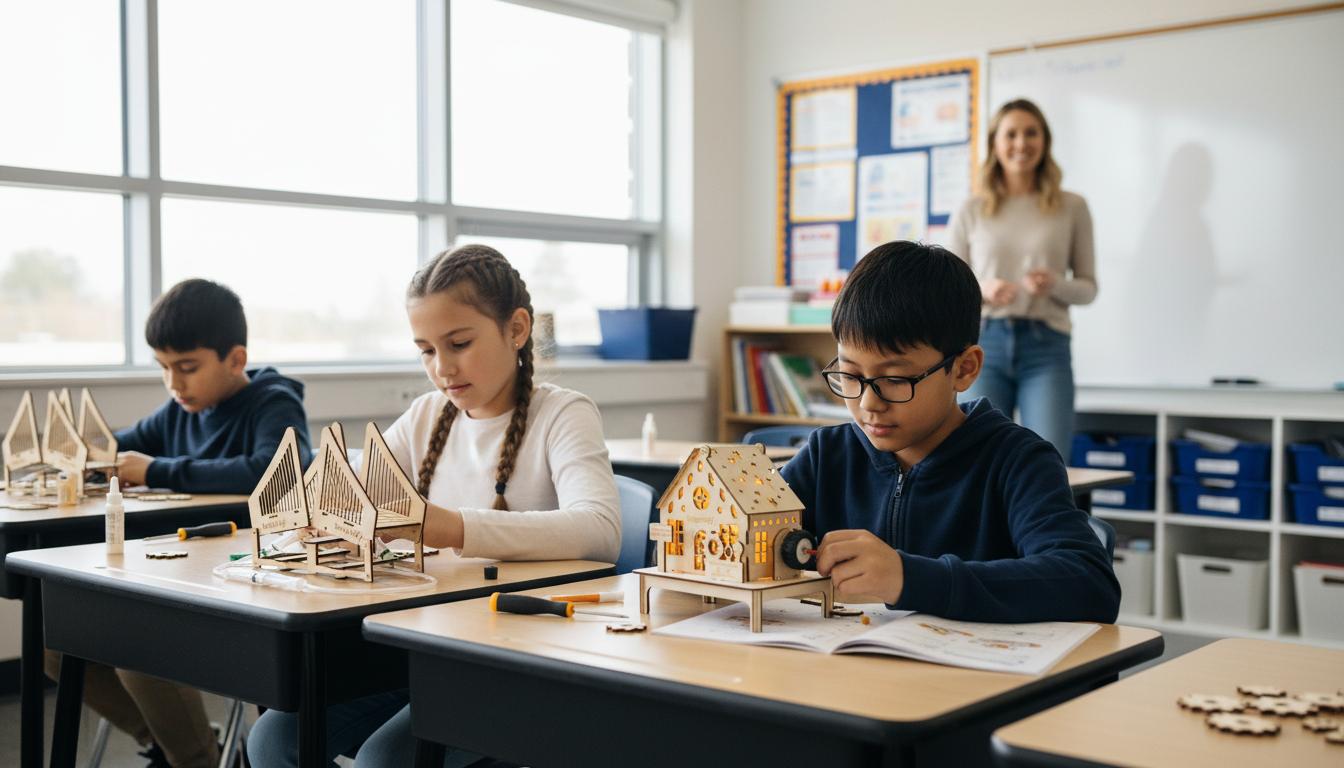
Students build independently using the animated guide. The facilitator circulates and asks questions rather than giving answers. The productive struggle is the point. This is where the career-ready habits form - the persistence through difficulty, the diagnosis of failure, the adjustment and retry.
Step 3 - Test and Iterate (15 Minutes)
When the model is complete, it works. The child tests it, adjusts it, tests again. This iteration loop mirrors exactly what engineers, scientists, medical professionals, and entrepreneurs do every day in careers that did not exist ten years ago.
Step 4 - Take It Home (Same Day)
The completed working model goes home with the child. That moment - kit in the bag, heading home - is where the word-of-mouth begins. And where the learning consolidates. The child becomes the teacher at the dinner table. Research shows students who explain what they have learned retain it at rates two to four times higher than those who review material passively. Interested in learning more about STEM Kits? Check out our complete guide.
|
Step |
What Happens |
Career-Ready Skill Built |
|
1 - Frame the challenge |
2-sentence problem introduction, no answer given |
Comfort with ambiguity and open-ended challenges |
|
2 - Independent build |
Student follows guide, facilitator asks not tells |
Persistence, sequential thinking, self-direction |
|
3 - Test and iterate |
Model tested, adjusted, retested until it functions |
Diagnostic reasoning, productive failure tolerance |
|
4 - Take it home |
Working model goes home the same day |
Communication, ownership, identity as a builder |

Why Camp Directors Choose Inspirely Over Coding and Robotics?
The camp market is saturated. Every camp offers coding. A growing number offer robotics. Both require significant facilitator training, expensive equipment, and produce outcomes that are difficult for parents to see or understand.
STEM kits require none of that. A camp director can run a full STEM building day with zero engineering expertise on staff. The kits arrive ready. The build guides are self-contained. The facilitator role is oversight and encouragement, not instruction.

The outcome is something no coding or robotics program produces: every child leaves with a working model in their hands. Every parent who picks up their child sees it. Every parent who sees it asks about it. And every parent who asks about it has already heard - from their school board, from the minister, from a headline - that hands-on, career-connected learning is exactly what their child needs. Your camp just gave them proof.
|
The Camp Differentiation Problem - Solved Most camps compete on price, location, and counsellor-to-camper ratio. Camps that run Inspirely STEM kit sessions compete on something else entirely: a certified experiential learning session that builds career-ready skills and follows the child home. You cannot out-LEGO a LEGO camp. You can out-experience every camp in your market with one session that produces a working take-home model. |
Real Results - Schools and Camps Using Inspirely
Inspirely kits are used across schools and programs in Canada, including active fundraising partnerships with Simcoe County District School Board and vendor recognition from the Science Teachers Association of Ontario (STAO). Inspirely is also a member of the Ontario Camp Association and the Canadian Aboriginal and Minority Supplier Council (CAMSC), with vendor presence at the Canadian National Exhibition and Easter Fun Fest in Markham.
Every kit is STEM.org authenticated - independently validated by accredited educators against specific learning outcomes in science, technology, engineering, and mathematics. That authentication is the bridge between the school or camp's programming decision and the provincial curriculum frameworks that administrators are required to align with.
FAQs - STEM Kits for Schools and Camps
Why are governments across Canada and the US pushing experiential learning now?Because the gap between classroom instruction and career readiness is widening - and research shows experiential learning closes it. Ontario, BC, and Alberta have all embedded career-connected, hands-on learning into curriculum frameworks. The US Department of Education has made it a funded priority under Perkins V. Schools and camps that offer certified experiential learning programs are aligned with this shift - which affects funding eligibility, board approval, and parent confidence. |
Do teachers need engineering knowledge to run a STEM kit session?No. Inspirely kits include animated step-by-step build guides designed for students to follow independently. The teacher or facilitator role is to circulate, ask questions, and protect the productive struggle - not to teach the engineering concept. STEM.org authentication means the learning rationale is already documented and curriculum-mapped. |
How do STEM kits align with Canadian and US curriculum frameworks?STEM.org authenticated kits map to specific learning outcomes in science, technology, engineering, and mathematics - outcomes that align with provincial frameworks in Ontario, BC, and Alberta, and with US federal STEM education priorities. Schools can present Inspirely sessions as experiential learning programming aligned to board and ministry priorities. |
Can STEM kits be used as a school fundraiser?Yes. Inspirely's school partnership program gives schools 35 to 50 percent of kit revenue. At the 300-kit tier, a school earns between $6,000 and $10,000 while delivering a STEM.org authenticated, career-connected learning experience to every participating child. The fundraiser teaches while it raises - which makes board and principal approval significantly easier. |
What is the minimum order for a camp STEM program?The Ignite bundle starts at 6 kits - suitable for a small group session or a trial day. Most camps running a full STEM day order the Spark Day bundle of 18 kits. Camps running weekly or seasonal programming benefit from the volume pricing in the Maker's Week and Signature Season tiers. |
Build Career-Ready Students at Your School or CampSTEM.org authenticated kits. Curriculum-aligned experiential learning. Serving schools and camps across Canada and the USA.Contact hello@inspirely.education or visit inspirely.education |
Share:
The Best STEM Kits for 8, 9 and 10 Year Olds - What Actually Works?
The Fundraiser That Builds Career-Ready Students